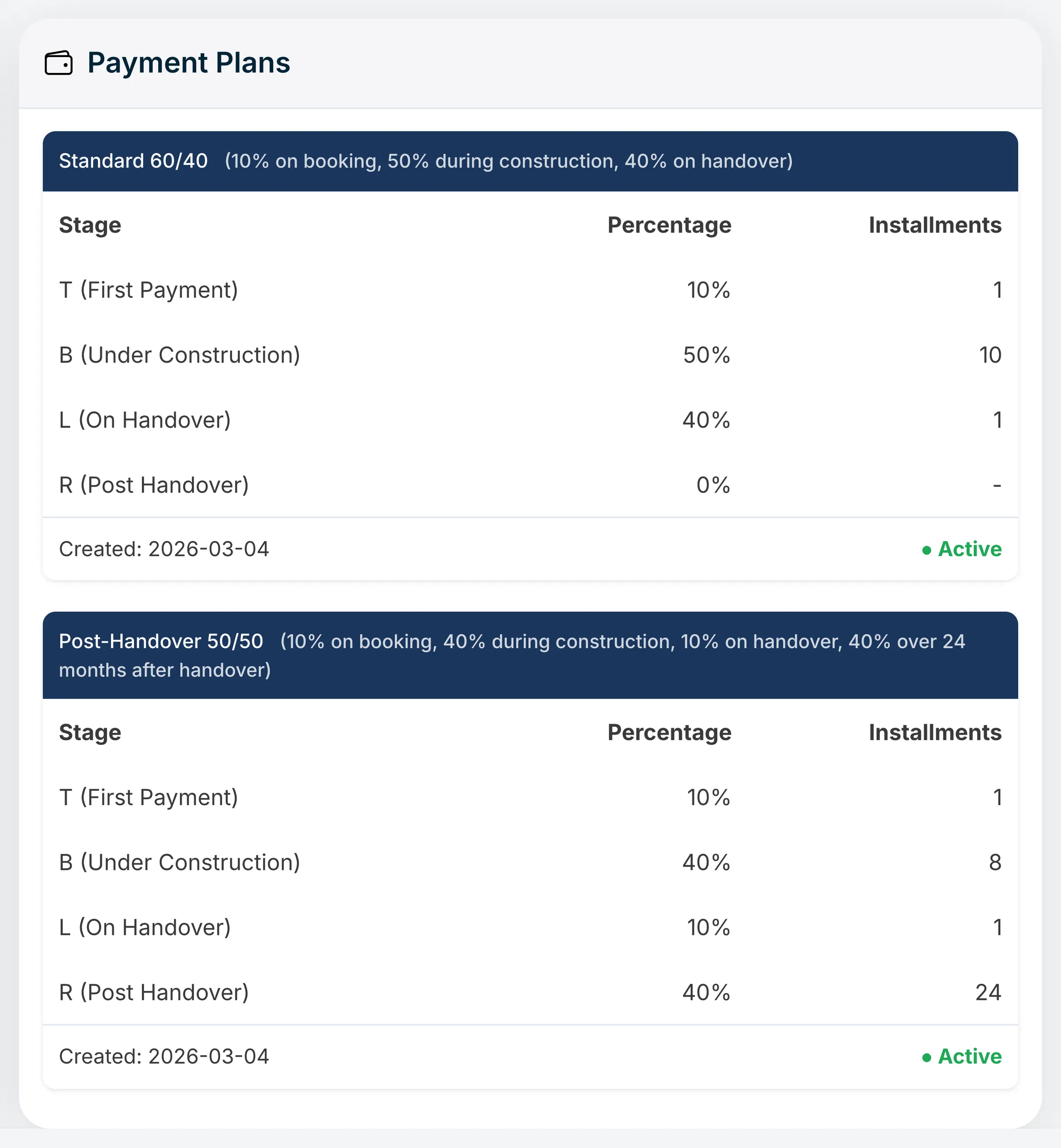
An off-plan payment plan splits the price into a down payment at booking, instalments while the building goes up, a payment on handover and, in some plans, instalments after handover. The name usually describes the split: a 60/40 plan asks for 60% before handover and 40% on or after it. To present plans well, show the same unit on two or three plans side by side, with the cash needed at booking, the fees on top of the price and what is left to pay, or to borrow, at handover.
How a plan is built
Whatever its name, every off-plan plan is made of the same parts:
- Down payment on booking, when the client signs the developer's booking form.
- Construction instalments, either on fixed dates, such as every month or quarter, or tied to construction stages, such as 20% or 50% completion.
- Handover payment, due when the developer hands over the keys.
- Post-handover instalments in some plans, spread over a period after handover.
The buyer pays into the project's escrow account, and DLD's FAQ explains the protection behind that: every amount received from buyers of off-plan units is deposited there, and the developer is paid from it as each construction milestone is reported and checked by the escrow trustee's engineer. For an instalment tied to a stage, the buyer can ask for a letter from the project consultant approved by DLD confirming the completion percentage before paying.
The developer's plan, on its price list and in the SPA, is the one that counts. Your proposal explains it; it never replaces it. The steps around the plan, from the EOI to Oqood registration, are in our guide to the off-plan sales process.
Common shapes
These are the shapes you will meet on developers' price lists, and what each one asks of a buyer. Names and splits vary by developer, so read the plan itself, not just its label.
- 60/40
- How the price splitsDown payment and construction instalments add up to 60%; 40% is due on handover.
- SuitsBuyers with cash now who will pay the rest, or borrow it, at handover.
- CheckWhether instalments follow dates or construction stages.
- 50/50
- How the price splitsHalf before handover, half on handover.
- SuitsBuyers who want to pay less during construction.
- CheckHow the large handover payment will be funded: savings, a sale or a mortgage.
- 1% monthly
- How the price splitsA down payment, then 1% of the price each month for a set number of months, and the balance on or after handover.
- SuitsBuyers with a steady income who prefer small, fixed payments.
- CheckHow many months run to handover, and how much is left at the end.
- Post-handover
- How the price splitsPart of the price is paid in instalments after handover, for example monthly over two years.
- SuitsInvestors who plan to let the unit and pay the instalments from the rent.
- CheckThe price against the same unit on a shorter plan, and the title deed, which is issued once the unit is fully paid.
Common shapes, not any developer's offer. The developer's price list and the SPA set the real plan.
Costs around the price
The price on the plan is not the whole cost. Show these next to it, each on its own line:
- DLD registration fee. Registering the sale in DLD's interim register (Oqood) costs 4% of the sale value. DLD's service page lists 2% for the seller and 2% for the buyer, plus AED 10 knowledge and AED 10 innovation fees. DLD's investor guide says the fee is shared equally unless the parties agree otherwise, so the SPA decides who pays which part. If a launch offer says the developer pays the fee, check the SPA says so too.
- Developer charges. Ask the developer for any administration or processing fees it adds, and get them in writing.
- Mortgage costs. DLD lists the fee for registering a mortgage as 0.25% of the loan. Banks set their own fees on top, so ask the bank for them in writing.
- At handover. DLD's service for issuing the title deed lists AED 250 for the title deed and AED 250 for the map of an apartment or villa, plus the AED 10 knowledge and AED 10 innovation fees. Ask for the expected yearly service charge as well.
- VAT. The Federal Tax Authority zero-rates the first supply of a residential property within three years of its completion, and its real estate guide treats buying a home off-plan from the developer as zero-rated. Later sales of homes are generally exempt, while commercial property carries the standard 5%. Services around the sale, such as an agency's commission, can carry 5% VAT.
Who pays which fee, and when, depends on the developer and the SPA. Write the assumption on the proposal, for example “DLD fee: 4%, paid by the buyer”, so the client can check it against the contract.
A worked example (illustration)
The numbers below are an illustration. “Project X” is a made-up building, the price is invented and the plans are not any developer's offer. They show how to lay three plans side by side for one unit.
A one-bedroom apartment in Project X costs AED 1,500,000, with handover about three years after booking. We assume the SPA puts the whole 4% DLD fee on the buyer, AED 60,000, paid at booking with AED 20 of DLD's knowledge and innovation fees. In a real sale, check the SPA.
- On booking
- 60/4010%: AED 150,000
- 1% monthly20%: AED 300,000
- Post-handover10%: AED 150,000
- During construction
- 60/4050%: five stage payments of AED 150,000
- 1% monthly36%: 1% a month for 36 months, AED 15,000 a month
- Post-handover40%: four stage payments of AED 150,000
- On handover
- 60/4040%: AED 600,000
- 1% monthly44%: AED 660,000
- Post-handover10%: AED 150,000
- After handover
- 60/40Nothing
- 1% monthlyNothing
- Post-handover40%: AED 25,000 a month for 24 months
- Cash at booking, with the DLD fee
- 60/40AED 210,020
- 1% monthlyAED 360,020
- Post-handoverAED 210,020
Illustration only: a made-up project, price and plans. Fees from DLD's service pages, checked 2 November 2026.
Read across the rows and the trade-offs show. The 1% monthly plan needs the most cash at booking but keeps the monthly payment small. The 60/40 plan asks for the least at booking and leaves AED 600,000 for handover. The post-handover plan starts at the same AED 210,020 and spreads AED 600,000 over the two years after handover: workable for an investor who lets the unit, as long as the client knows the title deed comes after the last instalment.
Then add the costs that come later. At handover, the title deed, map and DLD's small fees come to AED 520 for an apartment on DLD's current service page. If the 60/40 buyer borrows the AED 600,000 due at handover, the mortgage registration fee is 0.25% of the loan, AED 1,500, before the bank's own fees.
Mortgages and off-plan
The Central Bank's mortgage regulations set the most a bank may lend against a property's value. For a property bought off-plan the cap is 50%, whatever the buyer's nationality, the value or the purpose, because of the risk to completion. For other homes, the limit depends on who borrows, the property's value and whether it is a first home:
- First home, up to AED 5 million
- UAE nationals85%
- Expatriates80%
- First home, above AED 5 million
- UAE nationals75%
- Expatriates70%
- Second home or investment
- UAE nationals65%
- Expatriates60%
- Bought off-plan
- UAE nationals50%
- Expatriates50%
Maximum loan-to-value under the Central Bank's Regulations Regarding Mortgage Loans, Article 3, checked 2 November 2026. Up to AED 5 million means AED 5 million or less for UAE nationals and less than AED 5 million for expatriates. A bank can lend less.
The same regulations cap the term of a mortgage at 25 years and keep a borrower's total debt repayments within 50% of their gross salary and regular income. They measure the loan against the property's appraised value, from an independent valuation, not the price on the plan.
This shapes the plan you propose. A buyer who needs a large loan should look at plans with a large handover payment, which banks may finance once the home is complete, rather than borrowing during construction. Ask early whether the client will borrow, and suggest a bank pre-approval before booking: a plan that works on paper fails if the bank says no at handover.
Presenting two or three options to one client
One plan is a quote; three plans are a choice. A good proposal answers the client's real question, “what do I pay, and when?”, in a minute:
- Start from the client, not the brochure: the cash they have now, what they can pay each month and whether they will borrow.
- Pick two or three shapes that fit, for the same unit, so the plan is the only thing that changes.
- Show dates and amounts in AED, not just percentages, with the DLD fee and other costs on their own lines and the total at the bottom.
- Mark it as an illustration, with the date of the price list it uses. The developer's documents and the SPA decide the real terms.
- Send it as a link or a PDF the client can forward to a partner or a bank, and follow up once they have opened it.
Our page on payment plan proposals shows how Propfusion builds this comparison from a project or a sale listing, with the buyer fees and an optional mortgage estimate on each plan.
Two things to avoid: promising a return the developer has not put in writing, and quoting from an old price list. Plans can change between launch phases, so check the date before you send. When the client chooses, the plan carries into the booking; see how an off-plan sales CRM keeps EOIs, bookings and instalments together, and how new projects keep each project's plans on file. Buyers weighing off-plan for the first time can read our guide to off-plan properties in Dubai.
Where Propfusion fits
Build the comparison in minutes, not in a spreadsheet
A payment plan proposal in Propfusion puts up to three plans side by side for one client, on one of your company's off-plan projects or sale listings. Start from ready-made plans (60/40, 50/50, 1% monthly, post-handover, cash or mortgage-ready), the project's own plans or your company's templates, or describe a plan in plain words and AI drafts it. Every draft is marked “AI draft, check before sending”, nothing is saved until you click Looks right, and no client personal details are sent to the AI.
Each plan shows its schedule, buyer fees with 5% VAT where it applies, the total cost and an optional mortgage estimate. The client gets a private page in your brand, valid 14 days by default and up to 90, or a PDF, and you see when they opened it. It is an illustration, not an offer: it takes no payments, signatures or reservations.
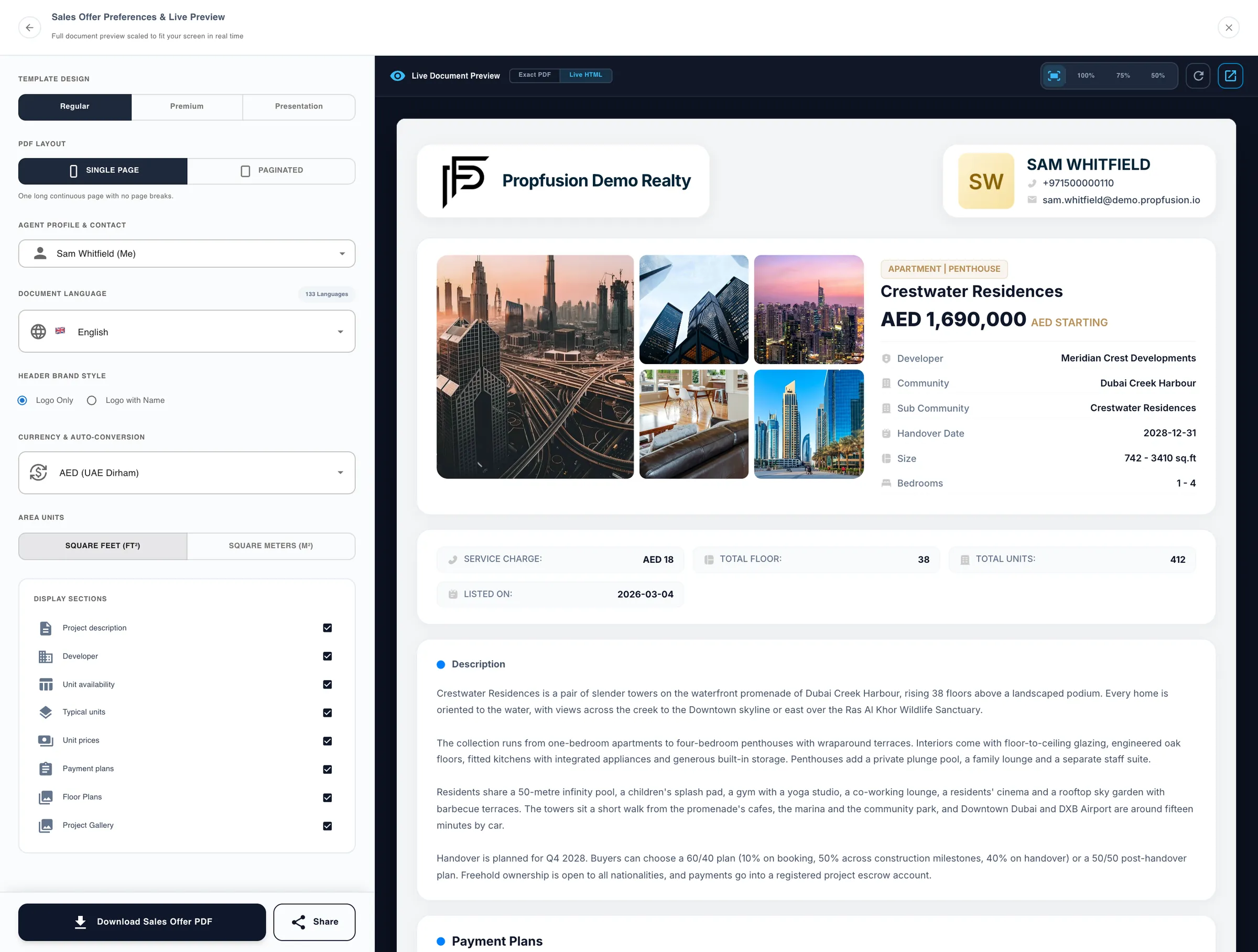
Screens show the Propfusion Demo Realty sample workspace. All people, listings and numbers are fictional.
Frequently asked questions
What does a 60/40 off-plan payment plan mean?
The buyer pays 60% of the price before handover, through the down payment and construction instalments, and 40% on handover. In a post-handover version the 40% is paid in instalments after handover. The developer's price list and the SPA set the exact dates and amounts.
How much can a bank lend on an off-plan property in the UAE?
At most 50% of the property's value under the UAE Central Bank's mortgage regulations, whatever the buyer's nationality, the property's value or the purpose of the purchase. A bank can lend less, so ask the bank early what it would lend towards the payment due at handover.
Which costs come on top of an off-plan price in Dubai?
DLD's fee for registering the sale, 4% of the sale value listed as 2% for the seller and 2% for the buyer, plus AED 20 in knowledge and innovation fees. Add any developer administration fees, mortgage costs if the buyer borrows, and the title deed and map fees at handover; the SPA says who pays each.
Is there VAT on an off-plan apartment in Dubai?
Not on a home bought from the developer: the Federal Tax Authority zero-rates the first supply of a residential property within three years of its completion, and its real estate guide treats an off-plan purchase from the developer as zero-rated. Commercial property is taxed at 5%, and services such as agency commission can carry VAT.
When does an off-plan buyer receive the title deed?
After completion, once the unit is fully paid. DLD's FAQ says that when a project is completed, fully paid units move from the interim register to the real estate register and the title deed is issued, so on a post-handover plan it follows the last instalment.
How many payment plans should an agent show one buyer?
Two or three for the same unit: enough to compare, few enough to decide. Show each with dates and amounts in AED, the fees on their own lines and the total, and mark the proposal as an illustration rather than an offer.
Sources
- Request to register the initial sale (Oqood e-service) · Dubai Land Department · checked
- Request to register a sale associated with an initial mortgage (e-service) · Dubai Land Department · checked
- Request to complete the initial procedures data: title deed (e-service) · Dubai Land Department · checked
- Frequently asked questions (escrow, registration, title deeds) · Dubai Land Department · checked
- Know Your Rights: for real estate investors in Dubai (PDF) · Dubai Land Department · checked
- Regulations Regarding Mortgage Loans, Article (3): Important Ratios · Central Bank of the UAE · checked
- Regulations Regarding Mortgage Loans (Article 1, definitions, and Article 2, valuation) · Central Bank of the UAE · checked
- How will real estate be treated? (VAT FAQ) · Federal Tax Authority · checked
- Real Estate VAT Guide, VATGRE1, April 2021 (PDF) · Federal Tax Authority · checked
- Payment plan proposals for Dubai property buyers · Propfusion · checked
Updated · Checked with AI tools against the product and official sources · How this page is made