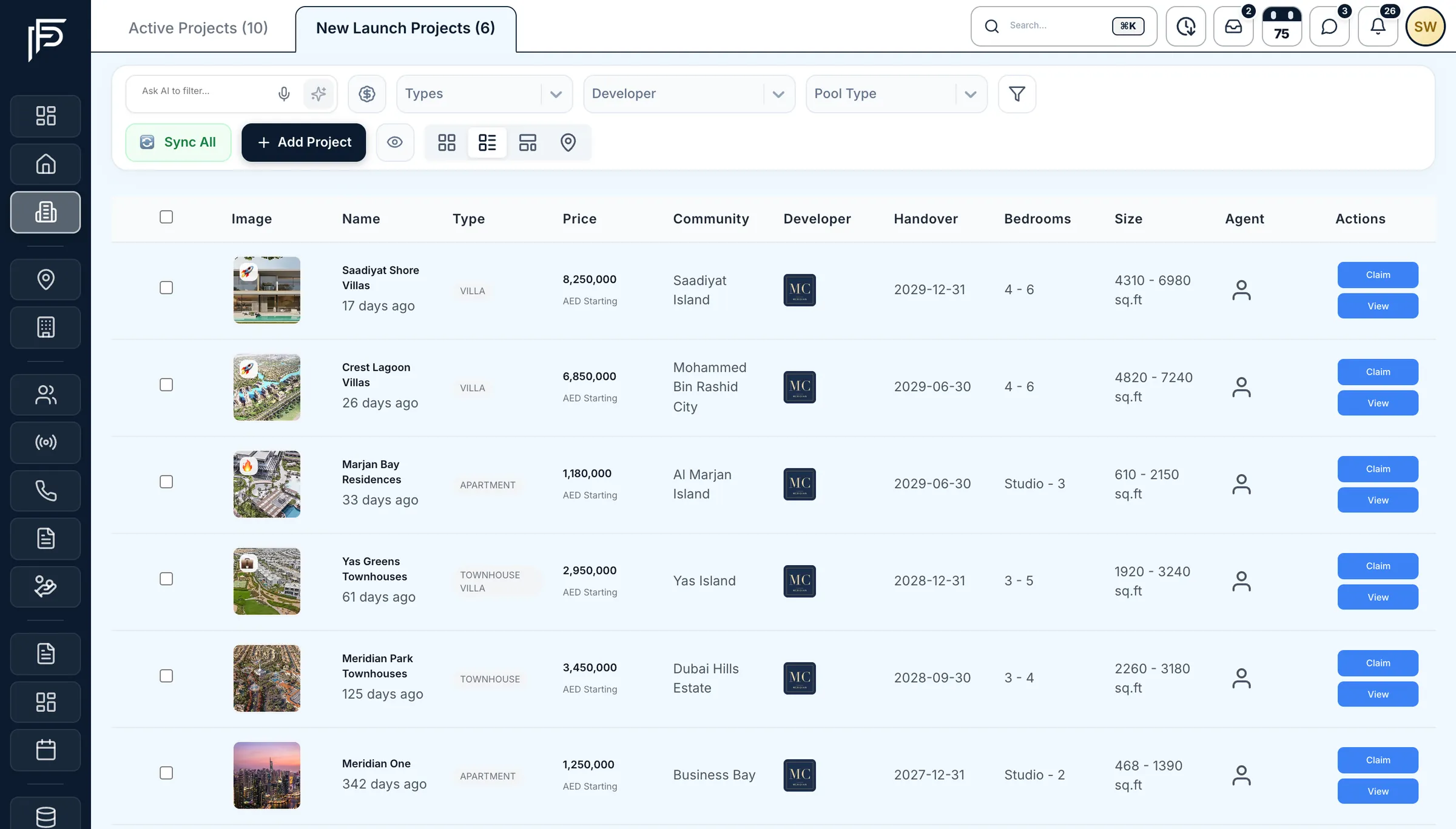
An off-plan sale in Dubai runs in a set order. The client registers an expression of interest (EOI) for a launch, the developer allocates a unit, the client books it with a down payment into the project's escrow account, buyer and developer sign the sale and purchase agreement (SPA), and the developer registers the sale in the Dubai Land Department's interim register through its Oqood portal. After that, the agent keeps the buyer on the payment plan and claims the commission from the developer under the marketing contract.
Before launch: a registered project, an escrow account and a marketing contract
DLD's Real Estate Brokerage Practice Guide (2nd edition, November 2024) sets three conditions before a brokerage markets an off-plan project. The project must be licensed and registered with the Real Estate Regulatory Agency (RERA). It must have an escrow account, and brokers must instruct buyers to deposit amounts for a unit only in that account. And there must be a marketing contract between the developer and your brokerage. You can check a project's registration in the Dubai REST app, under Mashrooi.
The developer has its own gate to pass: DLD's FAQ says a new project can be launched or announced only after all registration steps are complete and its accreditation certificate is issued. Promoting early has a cost. In May 2020 RERA fined a company for promoting projects that were not registered under its name and for receiving money outside the escrow account, and warned that the fine would double if it happened again.
Every advert for the launch, from a social post to a launch event, needs a DLD advertising permit through Trakheesi, with the permit number on the ad. A project launch event is a permit type of its own on DLD's ad permit page. Our Trakheesi permit checklist covers the steps.
From the developer, collect what the team will sell from: the price list and payment plans, the floor plans and brochure, the EOI terms, the escrow account details and the commission terms. Load them onto the project once, so every agent quotes the same plan; in Propfusion a project keeps its payment plans, floor plans and brochure together.
The EOI: token, terms and refunds
An EOI tells the developer that a client wants a unit at a launch, before units are allocated. It runs on the developer's own terms. The developer decides the amount, how it is paid, how it counts towards the booking, and whether and when it is refunded if no unit comes through. The sale itself is registered with DLD only after the SPA is signed, so at the EOI stage the developer's written terms are what your client has to rely on. Get them in writing before the client pays, and send the client a copy.
Keep to the escrow rule from the first dirham. DLD's guide tells brokers to instruct buyers to pay amounts for a unit only into the project's escrow account, so confirm with the developer how the EOI is paid and where it goes, and never take it through your own or the brokerage's account. For every EOI, record:
- the amount, the method (cheque, transfer or the developer's portal) and who received it;
- the developer's token or reference number, and a copy of the proof of payment;
- the client's unit preferences in order, their budget and the payment plan they want;
- whether they will need a mortgage, which changes the plan they can take (see off-plan payment plans explained).
Give the client an acknowledgement that the EOI was recorded, and make clear it is not a receipt: the receipt comes from whoever took the money.
Allocation day
Each developer runs allocation its own way, for example in the order EOIs were received or from a priority list. Ask how it will work, and how long clients will have to decide, well before the day. Then prepare each client so the decision takes minutes:
- their unit choices in order, with an agreed fallback (another floor, view or layout) and a ceiling price;
- the payment plan they will take, if the launch offers more than one;
- the booking amount ready, in the form the developer accepts, with their ID documents to hand;
- a phone number where they can be reached during the allocation slot.
Agree in advance which alternatives the client accepts, so you never commit them to a unit they did not choose. Afterwards, update every EOI the same day: allocated, still waiting or refunded. A client who missed out should hear it from you first, together with the next phase or a similar project.
Booking: documents and the down payment
Booking turns an allocation into a sale. The client signs the developer's booking or reservation form and pays the down payment, and that money goes into the project's escrow account. DLD's FAQ says every amount received from buyers of off-plan units belongs there, and that the developer is paid from the account as construction milestones are reported and checked by the escrow trustee's engineer.
The registration that follows needs the buyer's documents. DLD's service page for registering the sale lists a copy of the SPA, a valid UAE ID and, for non-residents, a valid passport; a company adds its trade licence, a legally translated Arabic copy of its memorandum of association and a shareholder certificate. Collect them at booking, together with your own KYC. A client who pays in cash, or whose money comes from someone else, calls for a closer look under your anti-money-laundering procedures.
Fix the payment schedule at booking in dates and amounts, not only percentages, so the client, the developer and your finance team work from the same plan. A payment plan proposal sent before the launch speeds this step up: the client has already chosen.
The SPA and Oqood registration
The developer issues the sale and purchase agreement, and the buyer and the developer both sign it. The developer then registers the sale in DLD's interim register, which DLD's service pages call the provisional register, through the Oqood portal. DLD's service page sets the deadline: within 90 days of the contract being signed. The buyer receives the provisional registration certificate by e-mail, and that certificate is what you keep on file as proof the sale is recorded.
Registration is not a formality. DLD's investor guide explains that Law No. 13 of 2008 requires every sale of an off-plan unit to be recorded in the interim register, or it is void. If a developer refuses or delays registration, DLD's FAQ says the buyer can apply to its Real Estate Registration Assurance section with supporting documents.
The fee: DLD lists 2% of the sale value for the seller and 2% for the buyer, 4% in all, plus AED 10 knowledge and AED 10 innovation fees. DLD's investor guide says the fee is shared equally unless the parties agree otherwise, so the SPA decides who pays which part. Our guide to off-plan payment plans shows how to put these costs in front of a buyer.
Some clients will want to sell before handover. DLD's FAQ says an off-plan unit can be resold once the developer issues a no-objection certificate, so read the developer's conditions before you list it.
After the sale: instalments, handover and the commission
Each instalment goes into the escrow account on the dates or construction stages in the SPA. Before paying an instalment tied to a construction stage, the buyer can ask for a letter from the project consultant approved by DLD that confirms the completion percentage; DLD's FAQ says the buyer is not obliged to pay until the agreed stage is reached. Remind clients before every due date: DLD's investor guide notes that Dubai law gives developers a process to end an off-plan contract when a buyer defaults on payments.
At completion, DLD's FAQ says units that are fully paid move from the interim register to the real estate register, and the title deed is issued to the owner. Handover is also the natural moment to offer your next service, leasing the unit or reselling it.
The commission comes from the developer on the terms of your marketing contract. DLD's FAQ says that, unless the brokerage contract states otherwise, a broker receives the commission once the sale contract is concluded and registered with DLD, so keep the Oqood certificate with your invoice. When your company is registered for VAT, the tax invoice adds VAT at 5%. Agents' shares, co-listing splits and payouts then follow your own rules; our page on deals and commissions shows how that works in a CRM.
Who does what in a launch team
Launches go wrong at the hand-offs. One way to split the work:
- Sales manager: the developer relationship and the marketing contract, the allocation plan and which agent looks after which client.
- Agents: enquiries, EOIs, preparing clients for allocation, booking documents and the follow-up until the SPA is signed.
- Sales administrator: advertising permits, the booking checklist, SPA signatures and the Oqood certificates.
- Compliance: KYC on every buyer, and a second look at cash payments and money from third parties.
- Finance: commission invoices to the developer, agents' commission and the instalments falling due.
In a small brokerage one person may hold three of these jobs. What matters is that every step has a name next to it, and that its status is visible to the whole team rather than kept in one agent's phone. For the buyer's side of the same journey, see our guide to off-plan properties in Dubai.
Where Propfusion fits
Run the launch from EOI to deal in one place
Once a company admin turns on off-plan sales, your team records each EOI on the project, with the amount, the method, who received it, the developer's token and the proof, and follows it on a board from Submitted to developer to Allocated and Booked, with refunds and cancellations on record. Each booking has a checklist (ID or company documents, KYC, the booking form, down payment proof, the SPA and the Oqood certificate), and the deal is created from it with the buyer, unit, price and payment schedule filled in.
Agents on the deal are reminded 30 and 7 days before each instalment, on the due date and 3 days after it is overdue. It works in the web CRM, takes no payments, flags cash of AED 55,000 or more and money paid by someone other than the client for your compliance team, and registers nothing with DLD or Oqood.
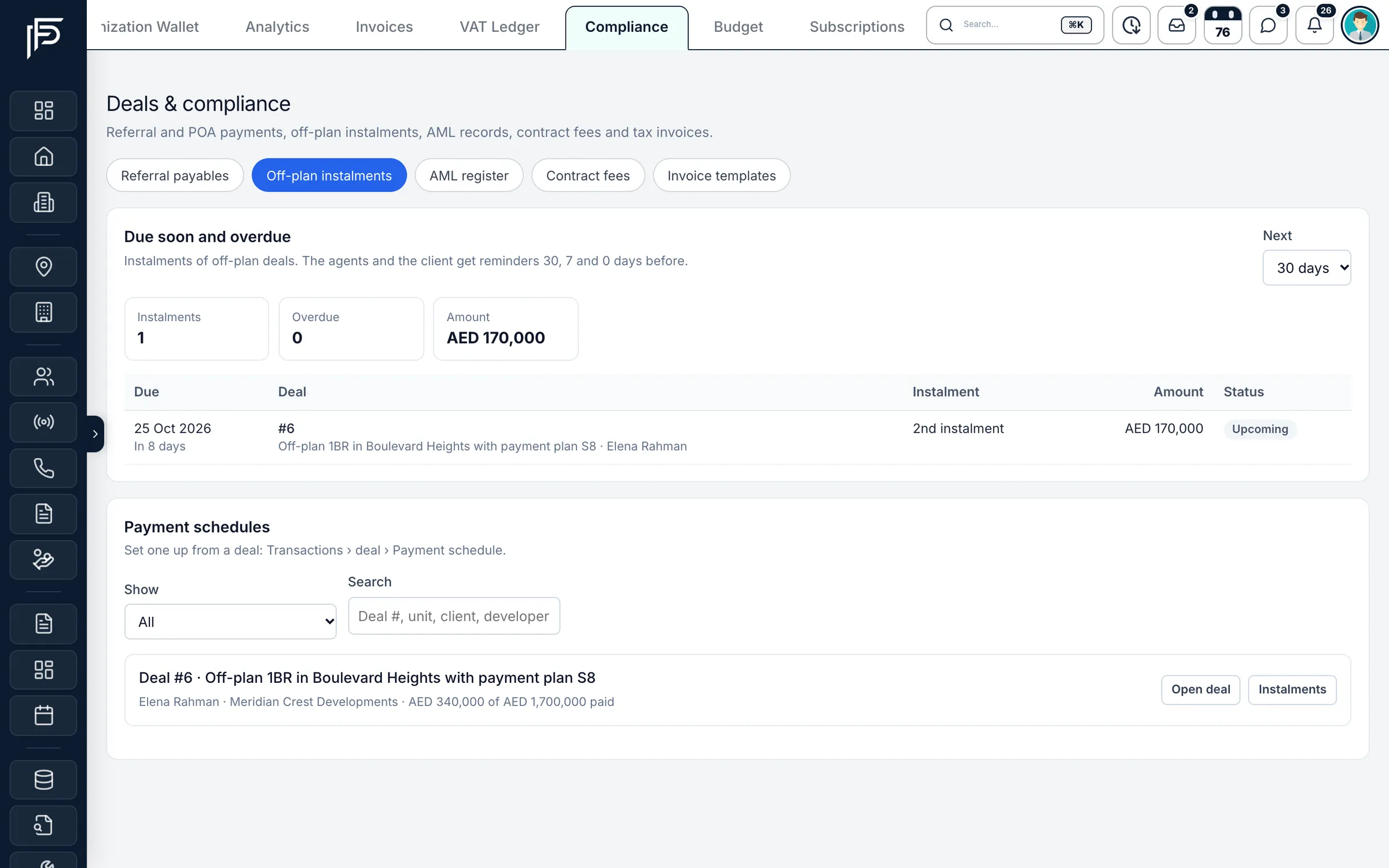
Screens show the Propfusion Demo Realty sample workspace. All people, listings and numbers are fictional.
Frequently asked questions
Who registers an off-plan sale in Oqood?
The developer. DLD's service page says the developer registers the signed sale and purchase agreement in the provisional register through the Oqood portal within 90 days of signing, and the buyer receives the registration certificate by e-mail.
Is an off-plan EOI refundable?
It depends on the developer. An EOI runs on the developer's own terms, which set the amount, how it is paid and whether and when it is refunded if no unit is allocated. Get those terms in writing before the client pays.
Where should an off-plan buyer pay the down payment?
Into the project's escrow account. DLD's brokerage practice guide tells brokers to instruct buyers to deposit amounts for a unit only in the project's escrow account, and DLD's FAQ says all amounts received from off-plan buyers go into it.
When is a broker entitled to commission on an off-plan sale?
When the marketing contract with the developer says. DLD's FAQ says that, unless the brokerage contract states otherwise, a broker receives the commission once the sale contract is concluded and registered with DLD.
What can a buyer do if the developer delays Oqood registration?
DLD's FAQ says the buyer can apply to register the contract through DLD's Real Estate Registration Assurance section, with supporting documents. DLD's service page gives the developer 90 days from signing to register the contract.
What should a brokerage check before marketing an off-plan launch?
That the project is licensed and registered with RERA, which you can check under Mashrooi in the Dubai REST app, that it has an escrow account, and that your brokerage has a marketing contract with the developer. Each advert also needs a DLD advertising permit through Trakheesi.
Sources
- Real Estate Brokerage Practice Guide, 2nd edition, November 2024 (PDF) · Dubai Land Department · checked
- Request to register the initial sale (Oqood e-service) · Dubai Land Department · checked
- Frequently asked questions (escrow, registration, brokers) · Dubai Land Department · checked
- Know Your Rights: for real estate investors in Dubai (PDF) · Dubai Land Department · checked
- Real Estate Ad Permit (e-service) · Dubai Land Department · checked
- DLD stresses need to adhere to real estate advertising laws (news, 9 May 2020) · Dubai Land Department · checked
- Value added tax (VAT) · UAE Government portal (u.ae) · checked
- Off-plan sales CRM for Dubai brokerages · Propfusion · checked
Updated · Checked with AI tools against the product and official sources · How this page is made