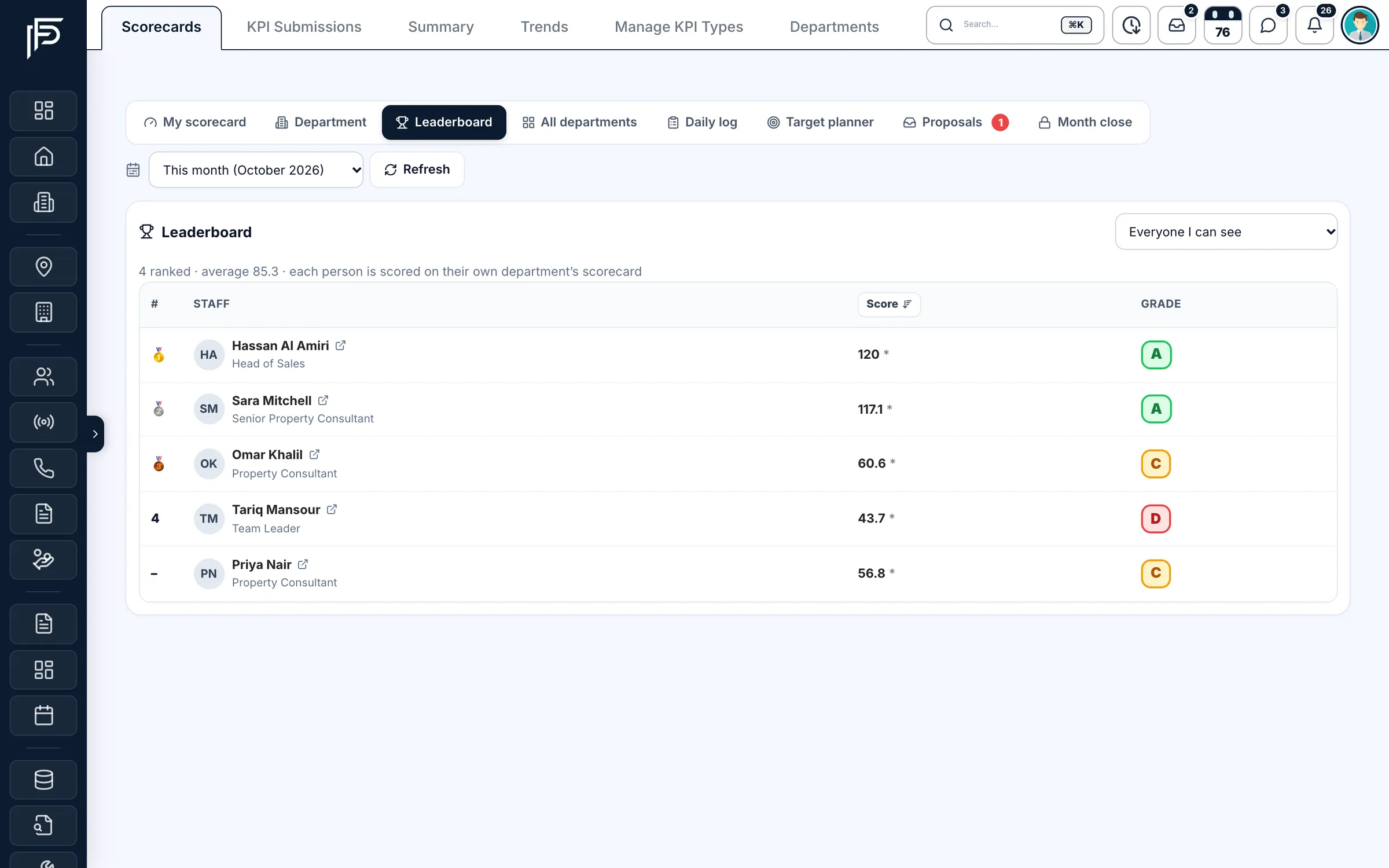
A workable scorecard for a Dubai agent has six to eight KPIs from three groups: activity (viewings, new listings), pipeline (leads answered on time, offers, follow-ups kept up to date) and results (deals closed, commission), each with a monthly target. Set the targets on the working days available, ramp new agents up, review the numbers weekly and freeze them at a monthly close, so pay and rankings come from one agreed set of figures.
Activity, pipeline and result KPIs
A KPI earns its place when two people counting it get the same number. Every KPI you could track falls into one of three groups, and each group answers a different question.
- Activity KPIs count work the agent controls day to day: viewings done, new listings published, calls connected, follow-ups completed. They are the easiest to change this week, but on their own they reward being busy.
- Pipeline KPIs show what is coming: offers made, leads answered within your response target, leads at viewing or negotiation stage, overdue follow-ups.
- Result KPIs are the outcomes: deals closed, commission earned, rental contracts signed, renewals. They decide pay, but they arrive late, and one large deal can hide a quiet month.
Then define each KPI by the event that counts. Count a deal on one fixed event, such as finance approval, not on the day someone says it was signed. Count a viewing when it is logged on a lead with a date and a client, not when it sits in a calendar. Say whose commission you count, the agency's or the agent's, and whether it is before VAT. Our guide to the KPI month close sets out these counting rules for the common KPIs.
Six to eight KPIs per role
Give each role a short list of its own, weighted by what matters most this quarter. Here is a starting point, not a standard:
- Activity
- Sales agentViewings done; new listings live with a valid permit
- Team leaderOne-to-one coaching sessions; their own viewings, if they also sell
- Leasing consultantViewings done; new rental listings live
- Pipeline
- Sales agentLeads answered within your target; offers made; overdue follow-ups (lower is better)
- Team leaderThe team's share of leads answered within target; the team's overdue follow-ups
- Leasing consultantLeads answered within your target; overdue follow-ups
- Results
- Sales agentDeals closed; commission (AED)
- Team leaderTeam deals closed; team commission; the team's average score
- Leasing consultantRental deals closed; annual rent closed (AED); renewals signed; Ejari registered within 7 days
A suggested starting point. The weights and targets are yours to set.
Specialist teams get lists of their own. An off-plan desk might count project presentations, site visits, EOIs collected and bookings closed; an admin team, deal files opened and deals with complete KYC for every party. The rule is the same everywhere: measure people on work their role actually controls.
Weights say what matters. If commission carries 30% of the score and viewings 15%, everyone can see the priority without a meeting (the figures are an example). Cap each metric too, so 300% on one KPI can't hide zeros on the rest.
Propfusion works this way. Each metric has a weight and a cap, 120% by default; everyone is scored on their own department's scorecard; and ready-made templates cover ten departments, from Sales and Leasing to Off-plan, Finance and Customer support. Work the CRM can't see, such as offers made by phone or site visits, comes from a short daily KPI form the agent fills in. The tour of targets and performance shows each screen.
Fair targets: working days, holidays and new agents
Agents accept a target when they can see how it was set. Three things make the difference.
- Working days. A month with Eid holidays has fewer selling days than one without. Set targets on the days available, and judge pace against the working days gone, not the calendar. The UAE's official public holidays apply to the private sector as well as to government, and Islamic holidays follow the moon sighting, so add them to the plan once they are announced.
- New agents. Someone in their opening month can't carry a full target. Give them a ramp: a lower target at the start, rising month by month to the full one.
- Who sets them. Targets come from someone accountable for them, never from the person measured, and they don't move during the month. If something big changes, such as long leave or a new area, change next month's target and write down why.
Propfusion builds these in. Each department has its own working days, holidays and grade bands, and pace is pro-rated by UAE working days. The target planner works months ahead per person, team or department, with Copy last month, a monthly ramp by a percentage and a new-joiner ramp. Team leaders propose targets, the department head or a KPI admin approves them, and nobody sets their own. More on KPIs and targets in Propfusion.
A weekly review and a monthly close
The two meetings do different jobs. Keep them apart.
The weekly review is for coaching. It is short and looks forward: who is behind pace, which leads are stuck, how many follow-ups are overdue, which new leads nobody has touched. The output is actions for this week, not verdicts. The numbers from a lead follow-up plan belong here. A half-hour agenda we suggest:
- Pace: each person's % of target against the working days gone.
- Stuck deals: offers and negotiations that haven't moved in a week.
- Follow-up hygiene: overdue follow-ups and new leads nobody has touched.
- One coaching point per person, written down and checked next week.
In Propfusion, PropFusion AI answers questions such as “Who is behind pace this month?” from the live scorecard.
The monthly close is the record. A few days after month end, once late approvals have landed, freeze each person's targets, actuals, % of target, grade and rank. Pay, bonuses and rankings use the frozen figures. A correction that arrives later is recorded next to the month with a reason, not written over it, and the month is re-closed openly when the change moves pay or a ranking.
In Propfusion, the month closes by itself on day 5 of the next month at 03:00 Dubai time by default. Until then it is provisional and worked out again every night, so late approvals still count. For 60 days after the freeze, a late change is flagged “Adj” instead of moving the result, an admin can re-close or reopen the month with a reason, and a closed month's targets can't be changed. Without a CRM, our free KPI month-close template builds the same sheet as a CSV in your browser.
Grades and leaderboards without gaming
A leaderboard is as fair as the numbers behind it. These rules keep it honest:
- Grade on % of target, with bands everyone knows before the month starts. Example bands: A at 100% or more, B from 85%, C from 70%, D below that.
- Count from records you can check: a viewing logged on a lead with its client, a deal approved by finance. Where a daily form covers work outside the CRM, spot-check it.
- Cap each metric, so one big deal can't hide the rest of the month.
- Credit shared deals once, by each agent's share of the commission split.
- Compare like with like: score each person on their own department's scorecard, so sales and leasing can share one board fairly.
- Watch numbers that rise with no results behind them, such as viewings with no feedback or follow-ups closed with no note.
- Reward more than the top three. Streaks and personal bests keep the middle of the table interested.
Propfusion's leaderboard counts this way: deals count by each agent's share of the split, so a shared deal is never counted twice, and everyone is ranked on their own department's scorecard. Badges such as Target hit, hit streaks and Personal best are awarded when a month closes.
Privacy
A score is personal information about someone's work. Decide who sees what before you start, and write it down:
- Each person sees their own scorecard and grade.
- Team leaders see their team, department heads their department, and finance what affects pay.
- Colleagues see each other's ranks if you decide they should, and you say so before the month starts.
- Earnings, loans and payouts stay between the person, finance and admins.
In Propfusion, an agent's KPI score is visible to the agent, their team leader, their department head and KPI admins. Anyone marked as not sharing their KPIs is hidden from everyone else, and earnings can be kept private the same way. You decide whether agents see colleagues' names on the leaderboard, and badges stay private unless an admin shows them, even then without the numbers. Since the Targets & Performance release, each staff page carries the person's targets, twelve months of hit, near or missed results and the records behind each number. Agents see their score, grade and target rings in the app, and send their daily KPI numbers from the phone.
Where Propfusion fits
Targets, scorecards and a month close in one place
Propfusion plans monthly targets per agent, team or department and scores each person from leads, viewings, listings and approved deals, with A to D grades and a live leaderboard. Work outside the CRM comes from a short daily form.
The month closes by itself, late changes are flagged instead of rewritten, and every agent follows their score and pace on the web and in the app.
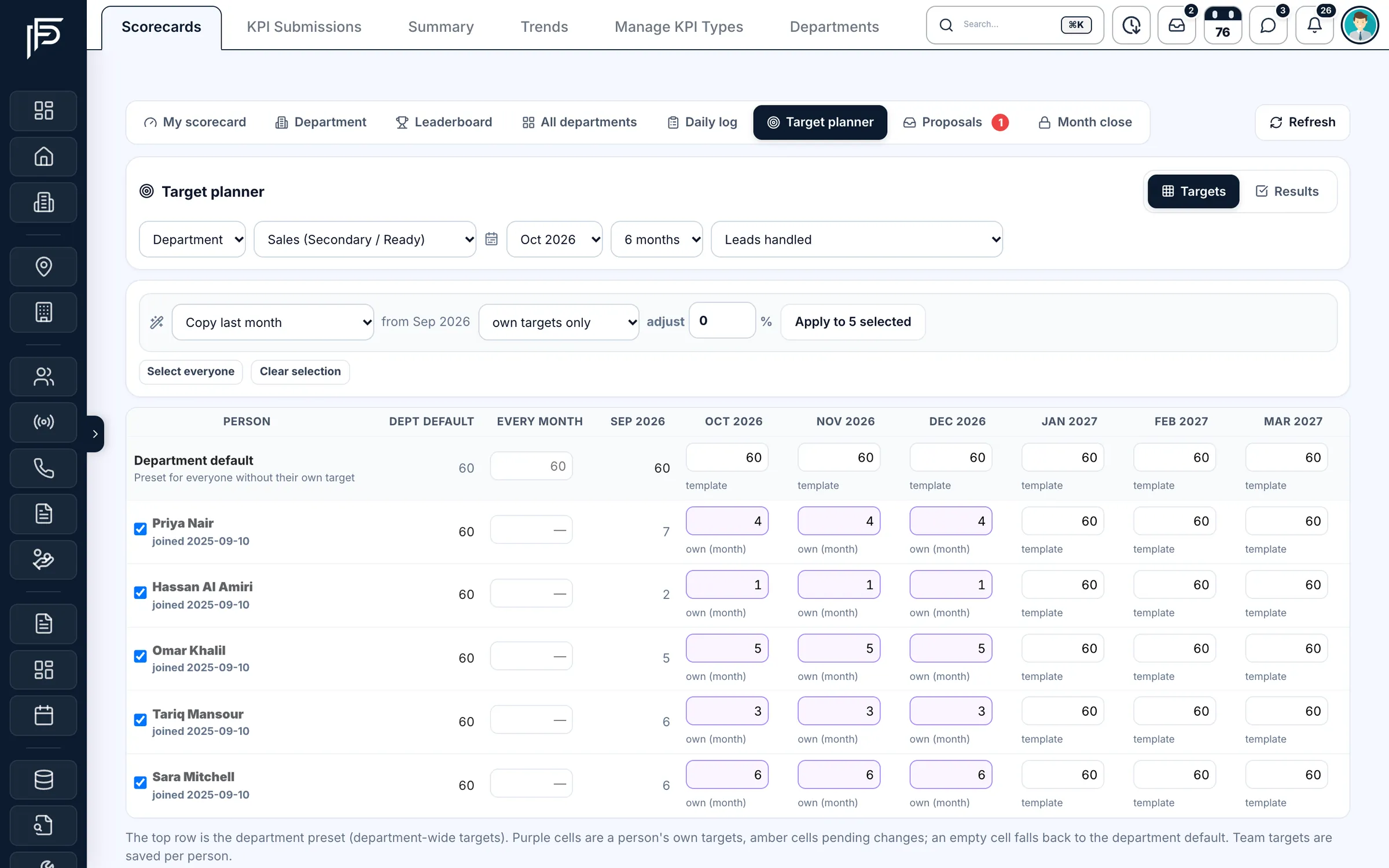
Screens show the Propfusion Demo Realty sample workspace. All people, listings and numbers are fictional.
Frequently asked questions
What is the difference between activity KPIs and result KPIs?
Activity KPIs count work the agent controls, such as viewings, new listings and calls. Result KPIs count outcomes, such as deals closed and commission. Pipeline KPIs sit in between: offers made, leads answered on time and follow-ups kept up to date.
How many KPIs belong on one agent's scorecard?
We suggest six to eight: enough to cover activity, pipeline and results, and few enough for everyone to remember. Weight the ones that matter most this quarter, and cap each one so a single big number can't hide the rest.
How should a brokerage set targets for a new agent?
With a ramp: a lower target in the opening months that rises month by month until it reaches the full one, agreed and written down before the agent starts. Propfusion's target planner has a new-joiner ramp for this.
Should agents see each other's scores on the leaderboard?
Decide before the month starts, and tell the team. You can show names and grades to everyone, or show each person their own rank and nothing more; in Propfusion you choose whether agents see colleagues' names in the ranking.
How do you stop agents gaming their KPI numbers?
Count from records you can check, such as viewings logged on a lead and deals approved by finance, and cap each metric so one figure can't carry the month. Watch for numbers that rise with no results behind them, and record any correction openly after the month closes.
Do UAE public holidays change an agent's monthly target?
They should, because they take away working days. The UAE's official public holidays apply to the private sector too, and Islamic holidays follow the moon sighting, so add them once the dates are announced and judge pace on working days.
Sources
- KPIs and targets for real estate agents, with a month close · Propfusion · checked
- Agent KPIs and targets that keep score for you (feature tour) · Propfusion · checked
- Targets & Performance for every team member (release notes, 15 October 2026) · Propfusion · checked
- How to run a KPI month close for a real estate brokerage · Propfusion · checked
- Free KPI month-close template for real estate agents (CSV) · Propfusion · checked
- Public holidays · UAE Government portal (u.ae) · checked
Updated · Checked with AI tools against the product and official sources · How this page is made