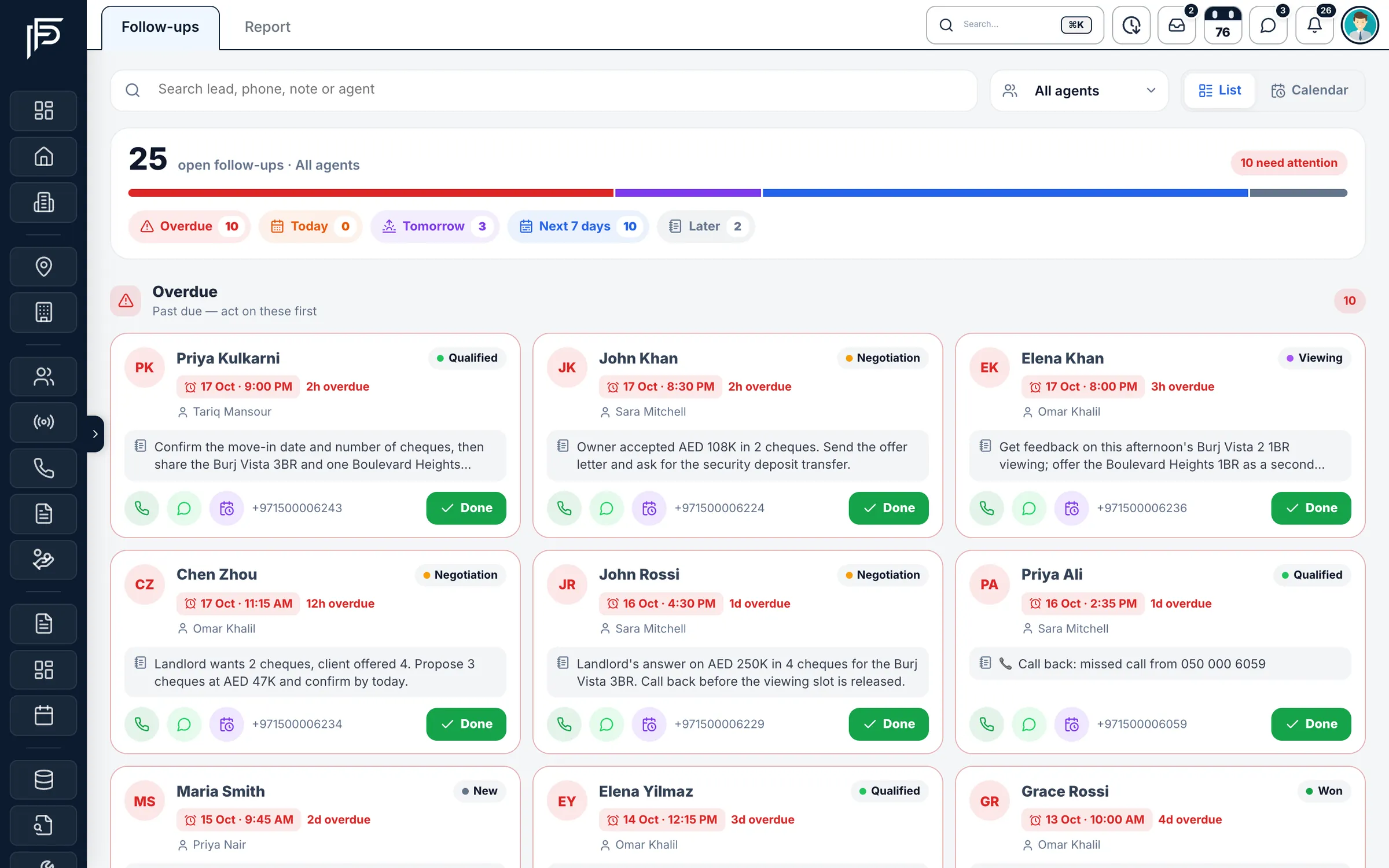
After the opening reply, follow up on a written plan rather than from memory. A workable plan is about six touches over 14 days, mixing calls, WhatsApp and e-mail, each one giving the client something new: options, a viewing slot or an answer. Stop the moment a client asks you to; otherwise, at day 14 either park the lead with a date further out or close it and write down why.
After the first reply
The opening reply is about speed, and our playbook on answering portal leads in 5 minutes covers it. This post starts once you have spoken to the client. From here, what keeps a lead alive is rhythm: no conversation ends without a next step and a date.
Before you hang up or close the chat:
- Write one line on the lead with what you promised and what the client is waiting for. For example: “Wants a 2-bed in JVC under AED 1.2m. Sending three options Thursday, call Saturday 11:00.”
- Book the next follow-up there and then, with a day and a time, not “next week”.
- Fill the gaps in what you know: budget, area, timing, cash or mortgage, and who else decides.
- Record the lead type, because it decides which rhythm below you follow.
In Propfusion, quick notes such as “Sent details on WhatsApp” set the next reminder at your company's default time, and a stage change asks for the next follow-up straight away, so the habit is built into the screen. The pipeline and follow-ups page shows how.
A 14-day plan by lead type
No rule or study we could check sets how many times to follow up. The plan below is a suggested starting point, not data. Adjust the days to your market, then keep the same plan for the whole team, so agents can be compared fairly.
- Day 1
- BuyerThree matching homes on WhatsApp, with one question: which one to see?
- TenantOptions with viewing slots for the next two days
- Off-plan investorBrochure, floor plans and the payment plan they asked about
- LandlordA call about the property, their price and their timing
- Days 2–3
- BuyerA call to book viewings; confirm the budget, and cash or mortgage
- TenantViewings; ask the move-in date and how many cheques
- Off-plan investorA call to walk through the payment plan and the handover date
- LandlordA pricing guide built from comparable sales
- Day 5
- BuyerViewing feedback, and a sharper search
- TenantFeedback the same day, with fresh options
- Off-plan investorTwo or three payment plans side by side, with the fees
- LandlordA visit: photos, measurements and the asking price
- Day 7
- BuyerNew listings or price changes in their area
- TenantStill looking? The newest matches
- Off-plan investorAn invitation to the sales centre or a video call
- LandlordThe listing agreement and the marketing plan
- Day 10
- BuyerA call: timeline, mortgage approval, who else decides
- TenantA short check-in
- Off-plan investorWhat is left: units, prices and plan changes
- LandlordFollow up on the agreement and answer objections
- Day 14
- BuyerA last check-in, then park or close
- TenantClose if they found a home; otherwise park until nearer the move-in date
- Off-plan investorA check-in, then launch news monthly if they agree
- LandlordSigned, parked until they are ready, or closed
A suggested rhythm, not a rule. Day 0 is your opening conversation with the client.
Why the plans differ:
- Tenants work to a move-in date, so their plan is the tightest. Ask for the date and the number of cheques early.
- Buyers of ready homes need viewings, then answers about money: mortgage approval, the deposit and the costs on top of the price.
- Off-plan investors compare launches and payment plans over weeks, so their touches are spaced out and carry documents, such as two or three payment plan proposals side by side.
- Landlords want evidence before they sign. A CMA, a pricing guide built from comparable sales rather than a valuation, makes the conversation with a seller concrete.
Which channel when
Each channel does a different job. A plan that uses one channel for everything is easy for a client to ignore.
- Phone, for decisions. Viewing times, budgets, objections and offers are easier to settle in a short call than over a day of messages. In Propfusion, calls through a company line are saved on the lead with their recording, and a missed call from a client becomes a call-back follow-up (see calls and call recording).
- WhatsApp, for what the client needs to see. Photos, a floor plan, a location pin, a brochure link and quick confirmations. If the client hasn't written in the last 24 hours, your WhatsApp has to be a template Meta has approved; our post on WhatsApp rules for agents explains why, and WhatsApp in the CRM shows how each chat sits on the lead.
- E-mail, for detail the client keeps. A payment plan, a contract to read, a market report.
- A viewing, for progress. Every plan above is aiming at one. Book it on the call and confirm it in writing.
Two habits help. When a client answers on one channel, carry on there, and don't send the same message on three channels at once. And if your company uses smart lead stages, the pipeline keeps up with the work by itself: starting a WhatsApp chat, a call or a booked viewing can move the lead forward to the stage you chose, with an undo (see the smart lead stages release).
Messages that get answers
A follow-up gets a reply when it is short, personal and asks one easy question. “Any update?” asks nothing. Here are sample texts we wrote; change the words in square brackets:
- Buyer, day 1: “Hi [Name], it's [Agent] from [Brokerage]. Here are three 2-bed homes in [Community] within your budget. Which one would you like to see?”
- Buyer, after a viewing: “Thanks for coming to [Building] today. Out of 10, how close was it? Tell me what would make it a 10 and I'll look for exactly that.”
- Tenant: “Hi [Name], a 1-bed in [Area] is free from [Date] at AED [Rent] a year. I can show it tomorrow at 6 or 7 pm. Which suits you?”
- Off-plan investor: “Hi [Name], I've put the [Project] payment plan next to [Other project] so you can see what you pay before and after handover. Shall I take you through it tomorrow at 11?”
- Landlord: “Hi [Name], similar units in [Building] sold between AED [Low] and AED [High] in the past six months. Shall we list at AED [Price] and review after two weeks?”
- Before you park a lead: “Hi [Name], I don't want to keep messaging if your plans have changed. Shall I check back in [Month], or would you rather I stop here?”
The last one matters most. It gives the client an easy way to say no, and a “not now” tells you when to come back. If you send the same follow-up often, save it as a template, and have the WhatsApp version approved by Meta before you need it.
Parking and closing a lead
A lead that hasn't answered after 14 days isn't always lost, but it can't stay active forever: it fills the agent's list and blurs the reports. There are two exits.
- Park it when the client has a real reason to wait: a bonus in March, a lease that ends in the summer, a launch next quarter. Set one follow-up for that date, note the reason, and send nothing in between unless there is news they asked for.
- Close it when it is over, with a reason from a short, fixed list: bought or rented elsewhere; budget doesn't match the market; can't be reached; duplicate; not a real enquiry; asked us to stop.
A fixed list beats free text because you can count it at month end. If “bought elsewhere” grows, look at how fast the team replies; if “budget doesn't match” grows, look at what your adverts promise.
In Propfusion a lead's status sits beside its stage (active, deal, pool or inactive), so a lead you close can be marked inactive instead of deleted, with the reason in a note on the lead. A lead another agent might win can go to the shared pool instead. And when a client says stop, stop: a STOP reply on WhatsApp takes them off marketing messages, and marking the lead “Refused - don't call again” or adding the number to the do-not-call list keeps company calls away. WhatsApp's own policy asks businesses to respect requests to stop, whether they arrive on WhatsApp or anywhere else.
Measuring follow-up discipline
Follow-up discipline shows in a few numbers. Look at them every week, agent by agent:
- Overdue follow-ups at the start of the day. The target is zero.
- Active leads with no next follow-up booked. Each one is a lead nobody is working.
- Time to reply to new leads, against the target you set.
- Stage moves: how many leads each agent moved, and where they stall.
- Closed leads by reason, once a month.
In Propfusion, the Follow-ups page shows overdue, today, tomorrow and the next seven days for one agent or the whole team. The follow-up report counts today's, overdue and upcoming follow-ups, with the leads behind them by stage, and the agent stage report shows how many leads each agent moved and between which stages. Keep the team's other jobs, such as listing photos or a permit renewal, on a task board, so the follow-up list holds client contact and nothing else.
To turn these numbers into monthly targets and a fair scorecard, read our post on KPIs for real estate agents. In Propfusion, viewings and overdue follow-ups can already count on each agent's KPI scorecard.
Where Propfusion fits
Follow-ups that run the agent's day
Every agent sees their overdue, today's and upcoming follow-ups, with call, WhatsApp and Done on each card, on the web and in the Propfusion app. Quick notes set the next reminder, and a stage change asks for the next follow-up.
Managers see the same agenda for the whole team, and the follow-up report shows where leads are waiting, by agent and stage. A missed call from a client becomes a call-back follow-up.
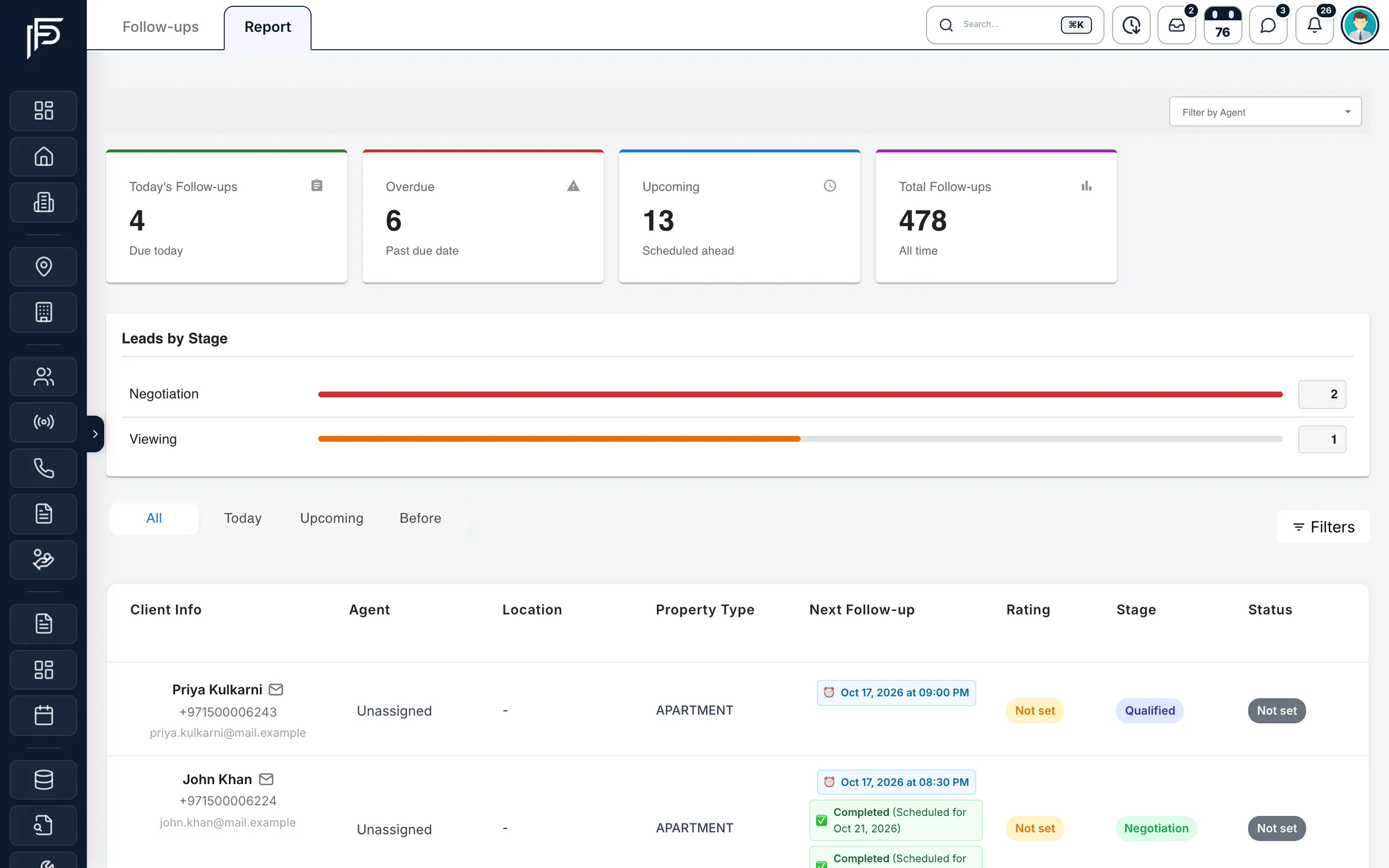
Screens show the Propfusion Demo Realty sample workspace. All people, listings and numbers are fictional.
Frequently asked questions
How many times should you follow up with a property lead?
No rule or study we could check sets a number. A workable plan is about six touches over 14 days, mixing calls, WhatsApp and e-mail, and then either parking the lead with a later date or closing it with a reason.
When should an agent stop following up with a lead?
At once if the client asks, on any channel. Otherwise, after the planned touches with no answer, park the lead with one follow-up on a date that matters to the client, or close it and note why.
Should property follow-ups be calls or WhatsApp messages?
Both, for different jobs. Calls settle decisions such as a viewing time or a budget, and WhatsApp carries what the client needs to see, such as photos or a location. If the client hasn't written in the last 24 hours, the WhatsApp message has to be an approved template.
What should an agent write in a follow-up note?
What was agreed, what the client is waiting for and when you will speak next, in one line. For example: wants a 2-bed in JVC under AED 1.2m, sending three options Thursday, calling Saturday at 11.
Can a call or a WhatsApp chat move a lead's stage in Propfusion?
It can. You choose which actions move a lead and to which stage: a WhatsApp chat started, a call, a viewing booked or a viewing done. Leads only move forward, and the lead shows what moved it, with an undo.
Which numbers show whether agents keep up with follow-ups?
Overdue follow-ups per agent, active leads with no next follow-up booked, the time to reply to new leads, and closed leads by reason. Look at them weekly. In Propfusion the follow-up report shows today's, overdue and upcoming follow-ups by agent and stage.
Sources
- Smart lead stages: leads move when your agents act (release notes, 24 October 2026) · Propfusion · checked
- Guided tutorials, one-tap follow-ups and live lead alerts (release notes, 4 October 2026) · Propfusion · checked
- Sales pipeline management, one clear stage at a time · Propfusion · checked
- Company phone calls inside your CRM: missed calls and call-backs · Propfusion · checked
- Service messages (the 24-hour customer service window) · Meta · checked
- WhatsApp Business Messaging Policy (last updated 23 September 2026) · WhatsApp · checked
Updated · Checked with AI tools against the product and official sources · How this page is made